
The most distinctive detail in the set. Tiling is bonded directly to the sprayed INSULTERM 600 face — no board, no furring, no board joints or screw heads behind the tiling. That saves 28 mm on every wet wall, which is net internal area recovered on every bathroom in a scheme. At 133 mm it is the thinnest build-up Solid System publishes.
D.05
Wet-area partition
Tabique de zona húmeda
133 mm
Total thickness · Revision 01 · 2026-08
D.05
Wet-area partition
SCALE 1:10
Dashed layers sit inside the stud cavity, not in addition to it. Keyboard navigable with the arrow keys; the same data is published as a table in the layer schedule below.
Photographs
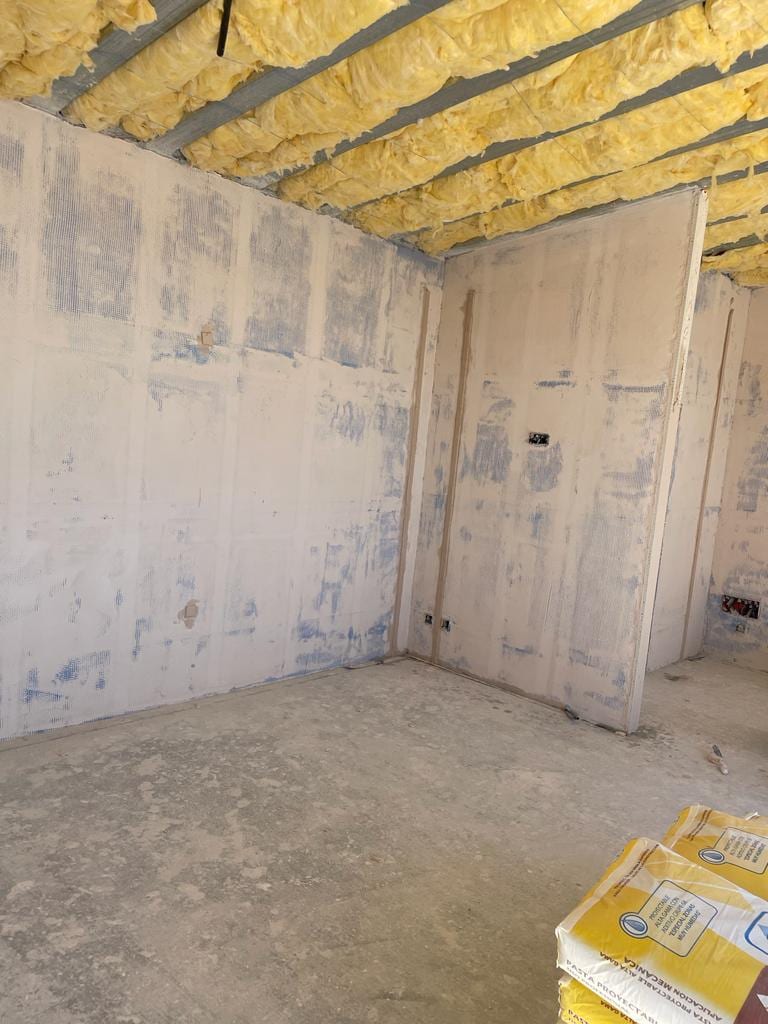
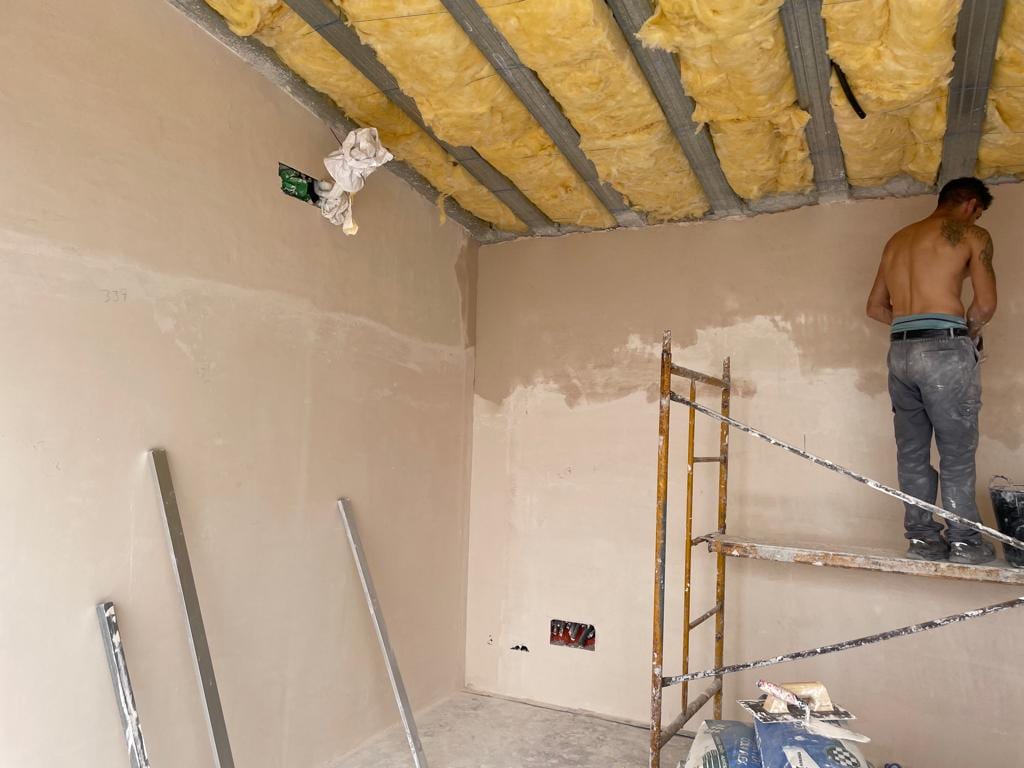
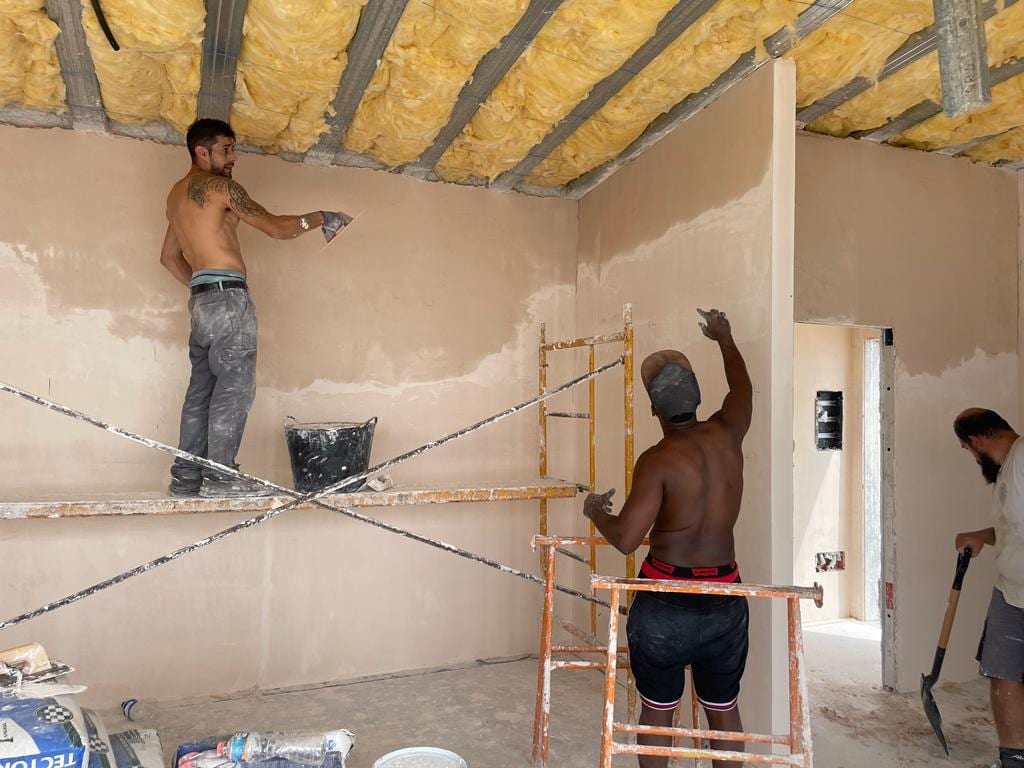
1 / 3
Layer schedule
| Layer | Material | Thickness | λ | Function |
|---|---|---|---|---|
| 1 Pladur plasterboard lining | Gypsum board | 13 mm | — | Internal finish to the dry side |
| 2 Omega furring profile | Cold-formed galvanised steel | 15 mm | — | Fixing profile for the lining, with a service void |
| 3 INSULTERM 600 in stud cavity | Sprayed thermal-acoustic conglomerate | 25 mm | 0.138 W/m·K | Encapsulation |
| 4 Mineral wool in stud cavity | Rock wool | 40 mm | 0.039 W/m·K | Acoustic core ISOVER Alphatoit rigid rock wool panel, as in D.02. λD from the manufacturer's datasheet (FT_Alphatoit_ES, 14/03/2024), to EN 12667 / EN 12939. |
| 5 INSULTERM 600 in stud cavity | Sprayed thermal-acoustic conglomerate | 25 mm | 0.138 W/m·K | Encapsulation, and the face the tiling is bonded to |
| 6 C90 steel stud cavity | Cold-formed galvanised steel | 90 mm | — | Framing — the cavity contains layers 3, 4 and 5 |
| 7 Tile adhesive | Cement-based tile adhesive | 5 mm | — | Bonds the tiling direct to the sprayed face |
| 8 Ceramic wall tiling | Ceramic wall tile | 10 mm | — | Wet-area finish |
| Total | 133 mm |
An em dash means the source document does not state that value; it is not a zero. Cavity-contained layers are indented — they sit inside the stud depth, so the column does not sum to the total.
Calculated performance
| Property | Value | Basis |
|---|---|---|
| U-value, bridging corrected | 0.60 W/m²K | EN ISO 6946, one-dimensional steady state, with a +20% bridging correction applied as an engineering estimate. |
| Self-weight | 80 kg/m² | Mass estimate from the layers and dimensions in the source document. |
| Traditional equivalent | 129 kg/m² | Derived from the published self-weight and reduction percentage. |
| Weight reduction | −38% | Self-weight against the traditional equivalent build-up. |
| Fire resistance (EI) | Test programme in progress — contact technical department | Awaiting laboratory test report |
| Airborne sound reduction (R_A) | Test programme in progress — contact technical department | Awaiting laboratory test report |
| Watertightness | Test programme in progress — contact technical departmentBond strength testing to EN 1348 is in progress | Awaiting laboratory test report |
U-values are one-dimensional steady-state calculations to EN ISO 6946. Bridging correction is applied as an engineering estimate: +20% for walls, +15% for horizontal elements. 2D numerical analysis to EN ISO 10211 is in progress; values will be updated on completion.
Not yet stated
- EIFire resistance · in test
- R_AAirborne sound reduction · in test
- watertightnessWatertightness · in test
Test programme in progress — contact technical department
Weight against traditional
| Element | Solid System | Traditional | Reduction |
|---|---|---|---|
| D.05 Wet-area partition | 80 kg/m² | 129 kg/m² | −38% |
Where to use it
- Bathroom and kitchen partitions
- Tiled wall zones outside direct-spray areas
Design notes
- All plumbing on the tiled face must be set out before spraying. There is no chasing afterwards.
- Bond strength testing to EN 1348 is in progress. For shower and direct-spray zones we currently specify a liquid-applied membrane behind the tiling.
- 28 mm is recovered per wet wall against the traditional board-and-furring equivalent.